RSUs vs Stock Options: How to Actually Compare Public Company and Startup Equity
by David Teichner, Co-Founder, Accelerate HC
One of the most common conversations I have with candidates right now is around equity. They’re trying to compare an offer from a large public company with RSUs to a startup offer with stock options. They want to line them up neatly in a spreadsheet. You really can’t.
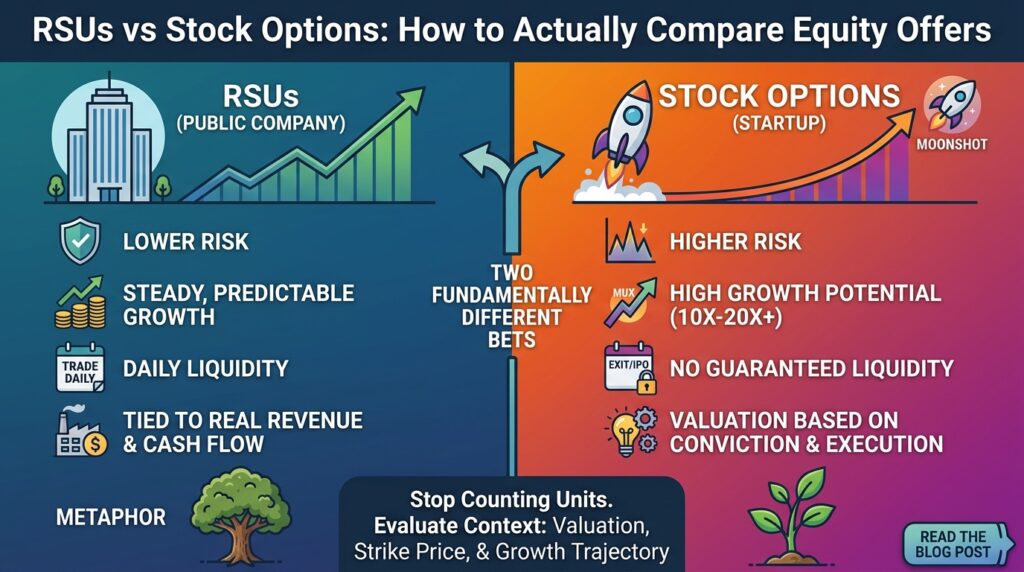
Two Fundamentally Different Bets
At a big public company, your RSUs are tied to a business with real revenue, real cash flow, analyst coverage, and daily liquidity. If things go well, maybe the stock doubles over 4–5 years. That’s meaningful. It’s steady. It’s lower risk.
At a startup, your options might be worth zero. Or they might be worth 10–20x in that same window if the company hits and you’re part of building something special. There’s no guaranteed liquidity. Just conviction, execution, and a lot of volatility.
Stop Counting Units
Here’s where people get tripped up: if you’re focused on the number of units, you’re looking at the wrong metric. The number of units means nothing by itself. Units do not equal value. And they definitely don’t equal upside potential.
What matters is the strike price, the current valuation, the growth trajectory, and the realistic exit scenario. Context is everything.

Know Which Bet You Want to Make
If you’re someone who loses sleep over downside risk, who values predictability, who prefers a known path — the large public company is a great option. If you’re wired to build, comfortable with ambiguity, and want a shot at disproportionate upside — both financially and in terms of impact — then the startup path makes more sense.
Neither choice is wrong. Just make sure you’re evaluating the right things before you decide.
The Real Takeaway
Short stints aren’t a dealbreaker, but patterns matter. Be thoughtful in how you hire. Be intentional in what you join. You can’t hold others to a standard you’re not willing to meet yourself.
Think About It | RSUs vs. Stock Options
When evaluating a new offer, performing a direct equity compensation comparison between established corporations and early-stage ventures is a common stumbling block for many candidates. Attempting to weigh RSUs vs stock options on a simple spreadsheet rarely works because they represent two fundamentally different financial bets. Public company RSUs offer steady, lower-risk value tied to a liquid market and real revenue, while startup options carry no guaranteed liquidity but offer the potential for massive, disproportionate upside if the company succeeds.

Instead of fixating on the raw number of units—which is a frequently misunderstood metric in modern SaaS compensation—candidates must evaluate the strike price, current valuation, and realistic exit scenarios. Ultimately, choosing between startup equity vs public company equity comes down to your personal risk tolerance and career goals. Whether you prefer the predictable financial trajectory of a large corporation or the high-risk, high-reward environment of building a startup, understanding the context of your equity ensures you make the right choice for your future.
Need help structuring competitive SaaS compensation? We advise on comp for every search. Hire Us.

Accelerate HC is led by David Teichner, lifetime entrepreneur based in Los Angeles. Throughout David’s career, he has founded and led several organizations that have raised capital, hired hundreds of employees, and successfully exited multiple companies.